Showing posts with label 14/15 SEM 1 BCS3473. Show all posts

12/08/2014

BCS3473 OOADD : Chapter 18 - Data Management Design

Chapter 18 - Data Management Design

Please download note (power point slide) here


Exercise

1.  What are criteria for a table design to be in:-
                          
                              i.    First Normal Form (1NF), how do you convert a normalized design to 1NF?
                            ii.    Second Normal Form (2NF), how do you convert 1NF design to 2NF design?
                           iii.    Third Normal Form (3NF), how do you convert 2NF design to 3NF design?

i.        A record is said to be in first normal form if it contains no repeating groups. To convert an unnormalized record you would expand the primary key of the record to include the key of the repeating group.

ii. To be in second normal form, a record must first be in first normal form and all fields that are not part of the primary key must be dependent on the entire primary key. To convert from 1NF to 2NF, you would create a new record for each field and a possible combination of the fields in the primary key. For each new record, designate one field or combination of fields as a primary key. Place the remaining fields with the primary key on which they depend. When finished placing the fields, discard any record that does not contain any additional fields other than its primary key. The remaining records are the 2NF of the original record.


iii. A record is in third normal form if it is in second normal form and if no nonkey field is dependent on another nonkey field. To convert a record to 3NF you would move the dependent field to a new record, which has the field it is dependent on as the primary key.


18.1  Give one example each of persistent object and transient object.
18.4 Outline the advantages and disadvantages of using a database management system over developing an application using files.
18.5 What is the key differences between a relational DBMS and object DBMS?

12/03/2014

BCS3473 OOADD UML Diagram

Please visit the following sites for UML Diagram tutorials.

2. Lucidchart.com
3. Tutorialspoint.com

Some of the most important diagrams that students need to familiar with are as follows:-

I. Use case Diagram
II. Activity Diagram
III. Communication Diagram
IV. Class Diagram
V. Sequence Diagram

12/01/2014

BCS3473 OOADD Chapter 5:Modelling Concepts, 6: Requirenments Capture, 7: Requirements Analysis

Review Question


Chapter 5: Modelling Concepts

I. What is the different between a diagram and a model?
II. What are the four elements of a UML diagram?
III. Why do we use models in developing computerized information system and other artefacts?

Chapter 6: Requirenments Capture

I. Name the five main fact-finding techniques and list one advantages and one disadvantages of each.
II. What is the purpose of producing the use cases?
III. Describe in your own words the differences between the <> and <> relationships in use case diagrams.


Chapter 7: Requirements Analysis

I. Explain what is meant by 'use case realization'
II. Distinguish between attribute and value
III. Distinguish between link and association.
IV. What is multiplicity.

11/16/2014

BCS3473 OOAD Test 1 Preparation

Contoh Soalan Ujian 1

Chapter 1
What is the differences between an information systema dn information technology?
What is the purpose of a management support system.
Define information. How does it differs from data?

Chapter 2
What is the main underlying causes of probels in information systems development?
What is the main differences between quality problems and productivity problems?
Define stakeholder.

Chapter 3
What are the advantages of the traditional waterfall lifecycle?
What are the disadvantages of the traditional waterfall lifecycle?
What is prototyping?
How does prototyping differs from inceremental development?

Chapter 4
What is polymorphism?
What does it mean to say that an object oriented is highly modular?

10/27/2014

BCS3473 OOADD : Quiz 1

QUIZ 1

1. Define object, class, instance and inheritance. (6M)
2. Consider Java program above and answer the following questions.

Java Code 1
2.1 Identify the superclass and subclass (4M)
2.2 Explain Generalization and Specialization. Use Java program above to support your explanation. (5M)

9/22/2014

BCS3473 Object Oriented Analysis and Database Design. Review Question

Review Questions for Chapter 1, Chapter 2 and Chapter 3 
Object Oriented System Analysis and Design, Simon Bennet.
Selected Question: 1.1,1.2,,1.7,1.10,1.11

Selected Question: 2.1,2,2,2.4,2.7

Selected Question: 3.1,3.2,3.3,
--------------------------------------------------------
Please download course plan and  lecture slide

9/10/2014

BCS3473 Object Oriented Analysis and Database Design. Week 1 Activity. UML

1. What is UML?

2. What is the purpose of UML?

3. Who is using UML?

4. Who create UML?

*5. List and Explain different types of UML Diagram.

*6. List at least three(3) software mainly   used to design UML Diagram?


9/08/2014

BCS3473 Object Oriented Analysis and Database Design

Tajuk biasanya menggambarkan isi kandungannya. Memahami dan menghayati setiap perkataan yang ada dalam tajuk membolehkan kita mendapat gambaran awal keseluruhan cerita dan memandu pemahaman menjadi lebih mudah.

Mari bermula dengan bertanyakan Pak Cik Google " What is Object Oriented Analysis and Design "


(WIKI)
Object-oriented analysis and design (OOAD) is a popular technical approach to analyzing, designing an application, system, or business by applying the object-oriented paradigm and visual modeling throughout the development life cycles to foster better stakeholder communication and product quality.

 (BUSINESSDICTIONARY)
The use of modeling to define and analyze the requirements necessary for success of a system. Object-oriented analysis is a process that groups items that interact with one another, typically by class, data or behavior, to create a model that accurately represents the intended purpose of the system as a whole. Object-oriented analysis does not factor implementation limitations into the model.


 Soalan kedua juga untuk Pakcik Google " What is Object Oriented Database"


(SEARCHORACLE.TECHTARGET)
An object-oriented database management system (OODBMS), sometimes shortened to ODBMS for object database management system), is a database management system (DBMS) that supports the modelling and creation of data as objects.

(COMTECHDOC)
Object oriented databases are also called Object Database Management Systems (ODBMS). Object databases store objects rather than data such as integers, strings or real numbers. Objects are used in object oriented languages such as Smalltalk, C++, Java, and others. Objects basically consist of the following:
  • Attributes - Attributes are data which defines the characteristics of an object. This data may be simple such as integers, strings, and real numbers or it may be a reference to a complex object.
  • Methods - Methods define the behavior of an object and are what was formally called procedures or functions.

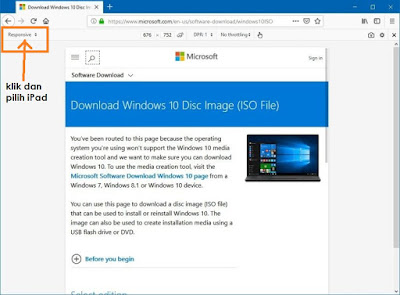
Cara download Installer windows 10 dalam format ISO

1. Jika anda bercadang untuk download windows 10 melalui website rasmi windows - pilihan untuk download dalam format ISO tidak di berikan.  ...